How to Future-Proof Schools Against AI Cheating
In the Midst of Cheating Scandals and Tech-Addicted Three-Year-Olds, a Core Question is Getting Lost in the Noise
This recent news story out of Brown University (published by Inside Higher Ed, July 8 2026) garnered national attention when an economics professor concluded almost his entire class had cheated using AI. It all started in January 2026 when Dr. Robert Serrano changed the structure of his economics courses. As a compassionate response to the terrible shooting at Brown during the previous semester exams, which understandably left many students shaken, Serrano announced his course would employ take-home exams.
Enrollment in his course immediately exploded from the typical 30 students to over 80. When these students took the take-home mid-term exam, the results were unbelievable. Historical averages on this test were in the 65-80% range, but the average take-home exam score was 94%.
“Literacy, computation, and a foundational body of knowledge about the world are necessary for every person, even in the age of AI. We’d better recommit to teaching those things - and fast.”
Dr. Serrano told students he found these results suspicious, and announced the final exam would be in person. 18 students immediately dropped the class. Of the remaining students who took the final exam, only two scored within five points of their midterm score. Over 40 students failed the in person final exam, many of whom had scored perfect 100’s on the mid-term.
Dr. Serrano published this scatterplot of student exam scores which tells the story in one image: Almost every student seems to have cheated on their mid-term exam. At Brown. Yes, the Ivy League.
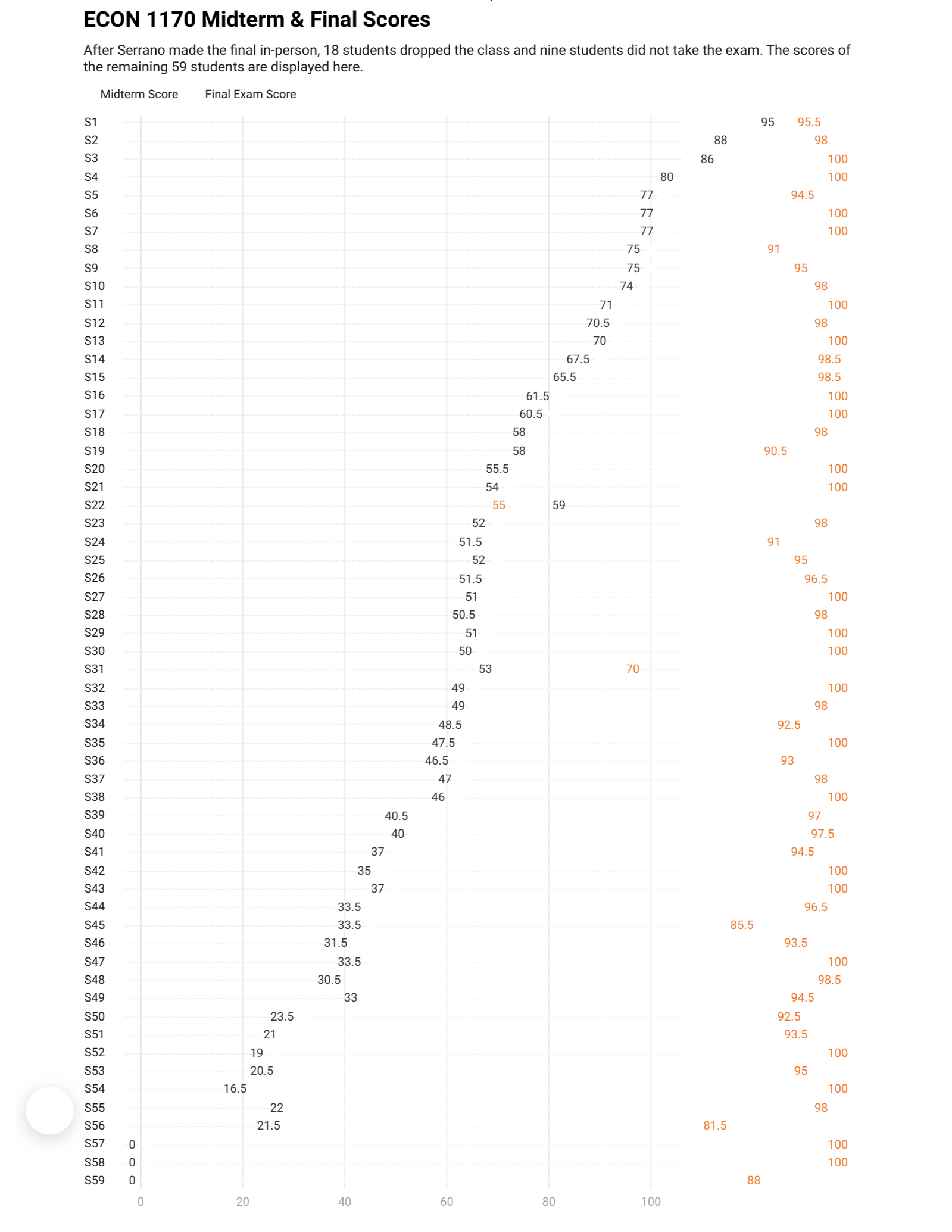
Scatterplot of Brown University Exam results with and without suspected AI use
This is not the first evidence of widespread cheating with AI, but the unavoidable data and blatant nature of this cheating has captured the national conversation. These are questions every parent, educator, student, and concerned citizen need to grapple with.
We Have to Keep Up
This problem is moving fast. The kids aren’t the same as they were before Covid, and that was only six years ago. Generative AI is less than five years old. By the time you read this blog post, there may well be a new tech influence in our classrooms. As a teacher, it’s hard to keep up (and if you’re like me, you’ve experienced an array of negative emotions on this topic - read here about AI and the Seven Stages of Teacher Grief).
“When Ivy League students outsource their thinking to AI, what’s the hope for my 6th graders? ”
So, what to do?
Well, the first step is to go back to the beginning and answer the foundational question: What is the purpose of education?
Educators must reevaluate this question any time there are societal shifts. We no longer require every student to learn Latin, and shorthand classes are hard to come by. Students used to use slide rules, but I’m not even sure what a slide rule actually does! So clearly, it’s appropriate to shift the educational program in keeping with technological and societal updates.
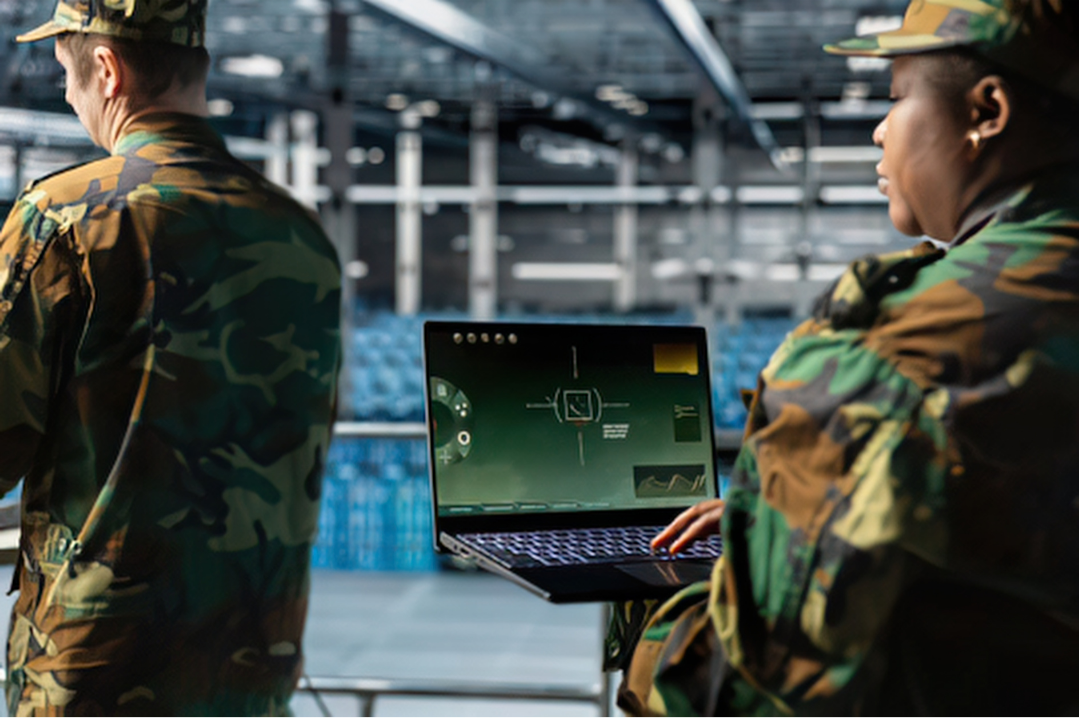
The U.S. Army learned it wasn’t enough for soldiers to calculate artillery targets by computer; they need to understand the principles of ballistics.
On the other hand, there are instances when learning “outdated” skills is valuable for understanding critical principles and concepts. My husband used to be an artillery officer in the U.S. Army. Calculating artillery trajectories is complex and includes variables including the weight of the projectile, precise angle and speed of projection, atmospheric conditions, and even the rotation of the earth! In the past, artillery crew members were subjected to a gruelling, logarithm-infused, five month course to learn to complete these calculations accurately. Soldiers learned to use “charts and darts” to accurately shoot a 100 pound shell over the heads of friendly troops to land on a one-meter square target nine miles away. This process required use of complex tools including a thick volume of firing tables, slide rules, and an enormous protractor referred to by firing crews as the “Klingon battle ax”
Happily, for several decades soldiers have been able to outsource this complex math to computer programs! No more worries!
Well, it didn’t take long for the military to discover that feeding information to a computer wasn’t adequate preparation for its fire direction crews. While the technology was very helpful for daily use, soldiers needed to understand the principles of ballistics in order to gut check, trouble-shoot, and problem solve in daily operations. And, the only way to develop this deep-seated knowledge was by building the skills from the foundation, step by painful step. The five-month artillery course came back.
The Question Getting Lost in the Noise
In the conversation about real issues with AI such as cheating scandals and job losses, another question is getting lost in the noise. Now that AI is available, what skills can be outsourced to it? And, what skills and knowledge do students still need?
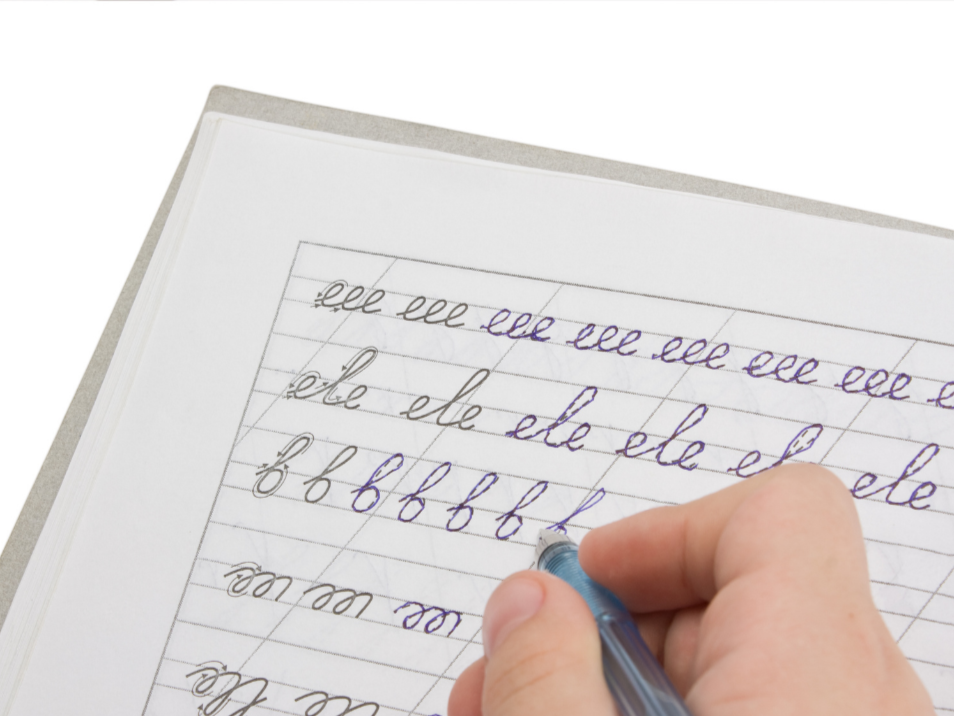
I underestimated the value of the soft skills needed for learning cursive: fine motor development, attention to detail, and patience
No question, there is some content that could be outsourced to AI, likely toward the upper / more specialized end of the curriculum. Technical work like coding, looking for trends in data, research, and complicated analytics; AI handles these tasks well. Do students or trainees still need to learn them? I can’t answer that specifically, but I believe experienced teachers in each respective field should be evaluating this question.
On the other hand, we risk AI making us dumber if we don’t insist on teaching a core body of knowledge. The dumbening has already started, but it’s not too late.
Do we want students to be able to read? Then we’re going to have to teach it.
Do we want kids to be able to handle some mental math, without resorting to a calculator for, say, 4x7? That means some time devoted to drill and practice. (“Drill and kill” is a misnomer; I’m not aware of anyone ever dying from practicing their times tables).
What about content? Is it important for students to understand some basic geography, citizenship, or facts about the environment or physics or medicine?
“Experienced teachers in each respective field need to evaluate which skills can be outsourced to AI, and which skills students still need.”
While we might quibble about the specifics, I think most informed people would agree that literacy, computation, and a foundational body of knowledge about the world are necessary for every person, even in the age of AI. If this is the case, we’d better recommit to teaching those things - and fast. This probably means getting rid of most of the screens, at least in K-8. It might mean bringing back some activities that require fine motor skills, attention to detail, and patience… like cursive. Ten years ago I was all for ditching cursive from the curriculum; now I have a deeper appreciation for the value that comes from the soft skills it required. That fine motor control is connected to children’s neurology, and we have all but eliminated it from the curriculum. I feel the same about memorization. Maybe there’s more value than I realized in memorizing poems, the state capitals, or the Preamble to the Constitution. It’s hard. It’s frustrating. And in addition to broadening your base of knowledge, it builds your academic stamina.

What areas do you believe are essential? What can be outsourced to AI? Have I overstated (or understand) the importance of maintaining a foundation of core skills?
Of course, the next question for teachers is “How?”. When Ivy League students outsource their thinking to AI, what’s the hope for my 6th graders? Never fear; sound instructional design is always the answer. But first, I think it helps to understand exactly why students cheat using tech. (Spoiler alert: It’s not just because they’re lazy!). Stay tuned for part 2 of this blog series to learn more!