How to Find Engaging Listening Texts
Finding current listening texts in the target language takes time, but it’s worth it! Here’s where start.
I volunteer as a leader in my church high school group. Last week as an icebreaker, we were asked to share the best gift we ever received. After the high schoolers shared their memories (of items such as a hydro flask, purple Uggs, and “Pickle”, the stuffed dinosaur from YouTube), I shared my best memory - a pink and grey double-cassette-deck boom box, ready for walking like an Egyptian, beach volleyball, and mix-tape recording. The high schoolers all laughed at me. Yes, I’m old.

It’s no secret that kids’ media habits have changed significantly, and this impacts us in the classroom. In my own high school French class (in the early 1990’s!) my teacher played the textbook cassette tape for a once-per-unit full-class listening practice activity. I remember listening so hard I felt like my ears would burst. And it was never enough. “I’m just not very good at listening,” I concluded. What I didn’t realize at the time was that my problem was lack of practice, not lack of aptitude. Fifteen minutes of target language listening per month just wasn’t enough.
So those days are behind us, and we have plenty of access to current, engaging listening texts. The challenge now is different: how do we find those great texts, and how do we use them when we find them?
Like always, the answer is to start with our students.
With the help of my colleague, Shelby Cole, we surveyed 172 high school students about what they listen to outside of class. Here’s what they said:
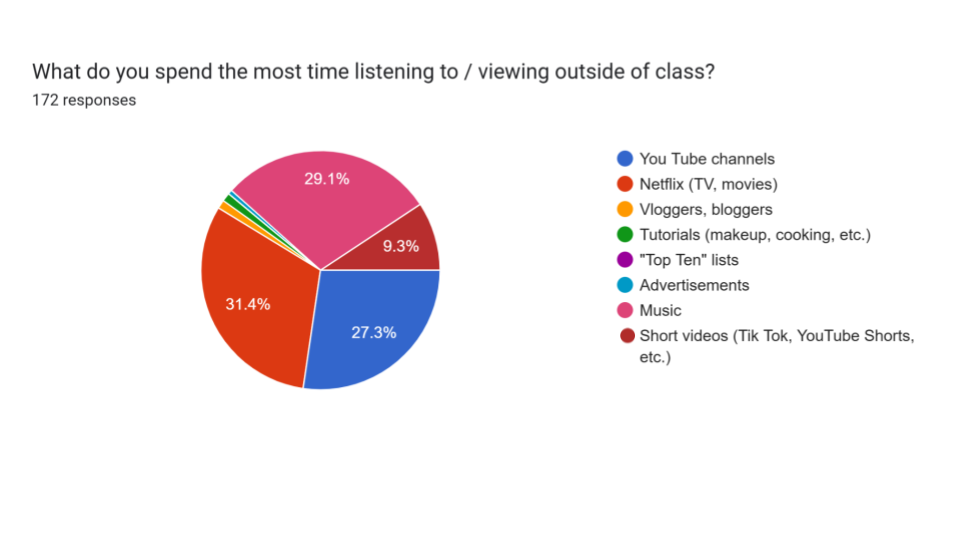
Students’ listening preferences
The top three sources of listening were music, YouTube videos, and Netflix / TV / Movies. In fact, 65% of students listen to at least one of those sources for over an hour per day.
Students also had some pointed advice for teachers!
“Watching YouTube videos aren’t always for entertainment, but for information on hobbies like video games or fishing. Listening to music is an easy way to relax and think about the day.”
“Keeping up with current trends and things students are interested in will allow for more engaging lessons.”
“It’s different from how you guys listened to media as a kid.”
(Yes, they love to remind me, I’m old!) That’s the bad news. The good news is, I don’t have to teach the same way I used to. And mirroring kids’ own listening habits are a great place to start.

It does take time to find good texts, and it takes skill to implement them effectively. In this post, I’ll share my top tips for finding appropriate target language texts, and next week I’ll share ideas for developing meaningful listening tasks.
Tips for finding engaging target-language listening texts:
Start small. Spend a little time each day poking around on YouTube, or set aside a bit of time each week. You don’t have to incorporate hours of new texts all at once. Embrace the process.
Build Your Library. Develop a record-keeping system to save potential resources. Sometimes when I find a great video, I’ll add the link to my folder for the appropriate unit: months later when I’m ready to teach that unit, I will thank my past self for the resource, and I may develop it out into a classroom activity.
Search Smart. Search using the target language browser (like Google.fr for French or Google.mx for Mexico). Use target language search terms, which are more likely to give you videos created by and for target language speakers.
Find libraries of high-interest videos. I’ve shared a few of my favorite French sources in this blog post.
“As a student, I thought I wasn’t good at listening. Later I learned my problem was lack of practice - not lack of aptitude!”
Use music. Pop songs are a wonderful source of current, authentic target language texts! Sites like Manie Musicale (French), Senor Ashby (Spanish) and ESL Songs (English) are wonderful sources for school-appropriate songs, and the accompanying teacher-created resources do a lot of the heavy lifting for you. Do you know of music-for-instruction websites for other languages? Share in the comments! And, read my blog series here for all my best tips to incorporate music in world language classes.
Use tutorials. Search in the target language for “How to… (insert your current topic). “How to make a quiche”, “How to serve a volleyball” and “How to draw a koala bear” - these types of tutorials are high-context, high-interest, and full of excellent vocabulary.
Share! When you find a great video (and create an accompanying resource) find a colleague to share with. Ask them to do the same. For French teachers, I have free curated listening texts on my TPT store. Check them out here.
Ask the Kids for Help. I have a standing offer of extra credit for any student who brings me a target language video that I use in class. The kids know what’s current, and they are really good at finding engaging videos. Sometimes I tell the kids I need something specific, and my army of Internet sleuths get to work on my behalf! The fact that they’re spending extra time listening to the target language outside of class is a bonus!
OK, so I remember the TV with a dial to change our 13 channels. I remember waiting for my favorite song to come on the radio so I could tape record it. Yes, I am old. But, I don’t have to “teach old”! With a little patience and determination, you can develop the habit of incorporating and updating your listening texts, keeping your class fresh and your students’ skills sharp. Bon courage!